


Ever notice yourself reaching for AI before trying to think through something on your own?
One sentence in an email, that’s all between me and the holiday weekend. Playing a live distractathon between things I must do and mind candy….I went for the candy.
Not because I didn’t know what to say. Because I’d get distracted when I started. So I ask ChatGPT to finish it. Then the next one. Then the entire email.
Few minutes later, I couldn’t draft anything without opening ChatGPT. And I’ve written a ton in my life.
Now this passed, still I’m not alone. Many would be lost now if ChatGPT went away. Not likely, but still a ton of trust to put on something that’s not trustworthy yet.
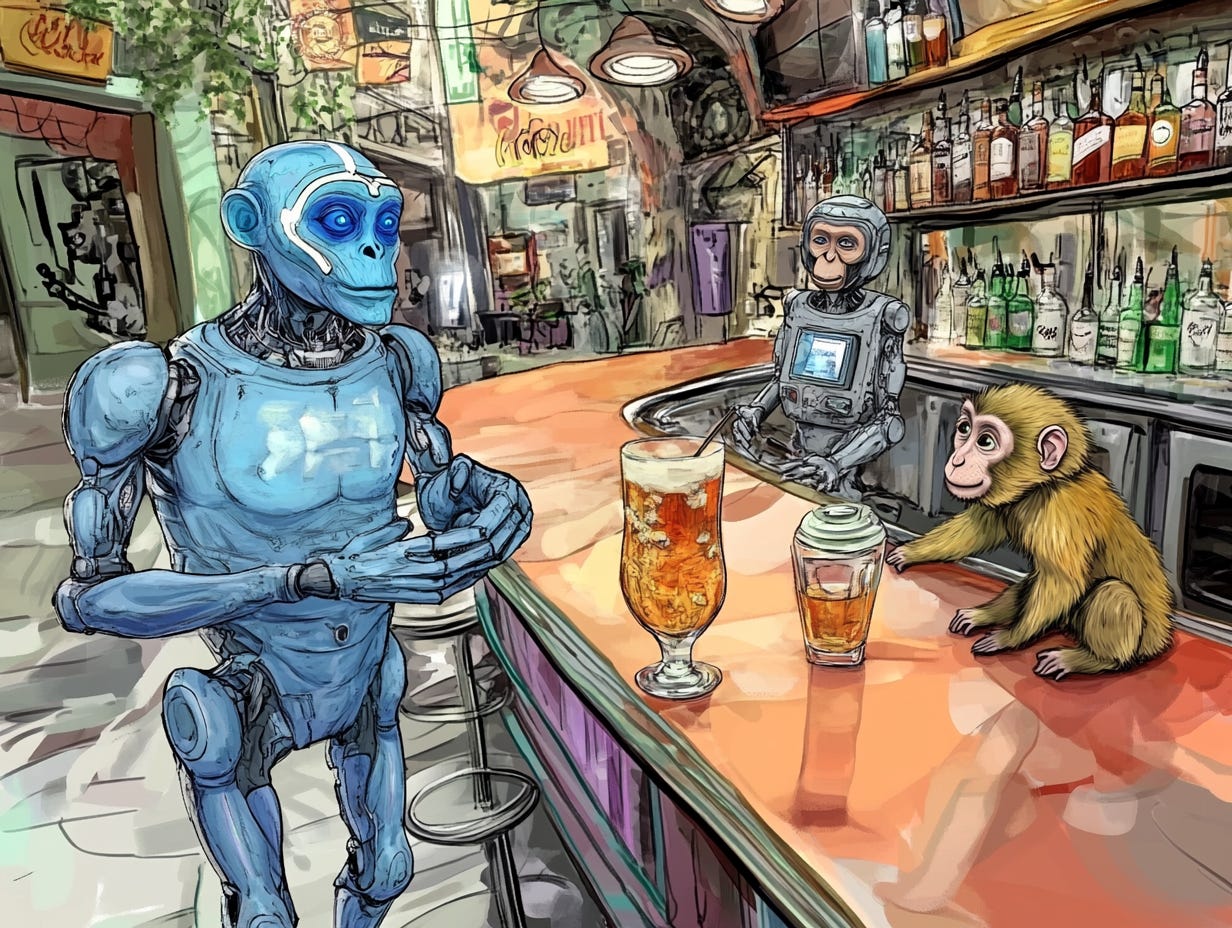
→ People who once wrote easy to read emails, turn into corporate word salads
→ People who made decisions in minutes now look to ChatGPT for confirmation (knowing they can’t trust the results).
→ Creators who had strong voices can’t remember what they sounded like after AI cloning it all.
One person told me: “I used to just... know what to write. Now I don’t trust myself to start without AI checking it first.”
When we outsource the thinking part of writing something else gets weaker. The muscle turning rapid thoughts into clear sentences. The innate knowing when something sounds like you.
It’s not like you wake up one day unable to think. More like using a paper map in a GPS world:
Reaching for AI before trying to figure it out yourself
Feeling foggy when you need to write something important
Not trusting your own judgment like you used to
The cost of speed is your thinking and problem solving; your mind, perspective, and confidence.
AI makes drafts in seconds, revises in seconds. Still we know speed and thinking aren’t the same thing, even if it’s really fun and easy to just use it.
What if the tool didn’t make us faster, but did make us dependent.
I’m not saying we abandon AI. I’m an advisor to one startup, and use it every day. Still the thing making us faster might also be making us... different.
Now is that different in a good way, depends on the person. Here’s what I’m testing, how to be different in my actions, and improve with AI.
Your Voice: Is It AI or Unfakeable You?
Most people can’t describe their own voice. It’s like asking a fish to describe water. I’m one of the fish here. (And AI hasn’t been much help beyond the obvious.)
Now let’s dissect it together. Not to criticize. To discover. I’ll share some of what came up for me, and play along, comment with questions. Everyone has their own way of using AI, which makes it less software and more you.
TLDR
Question 1: How do you start sentences?
Do you lead with questions? Statements? Stories?
Look at the first line of each paragraph. There’s a pattern.
Question 2: What words do you overuse?
Not “AI” or “business”; everyone uses those.
I mean the weird ones. I say “seriously” too much. “Honestly.” “Look.”
Those aren’t professional. They’re mine.
Question 3: What do you explain that others assume?
Some people over-explain. Some skip steps.
Neither is wrong. But it’s distinctive.
Question 4: What do you avoid saying?
I don’t use corporate speak. No “synergy.” No “leverage.” No “circle back.”
That’s not style advice. That’s who I am.
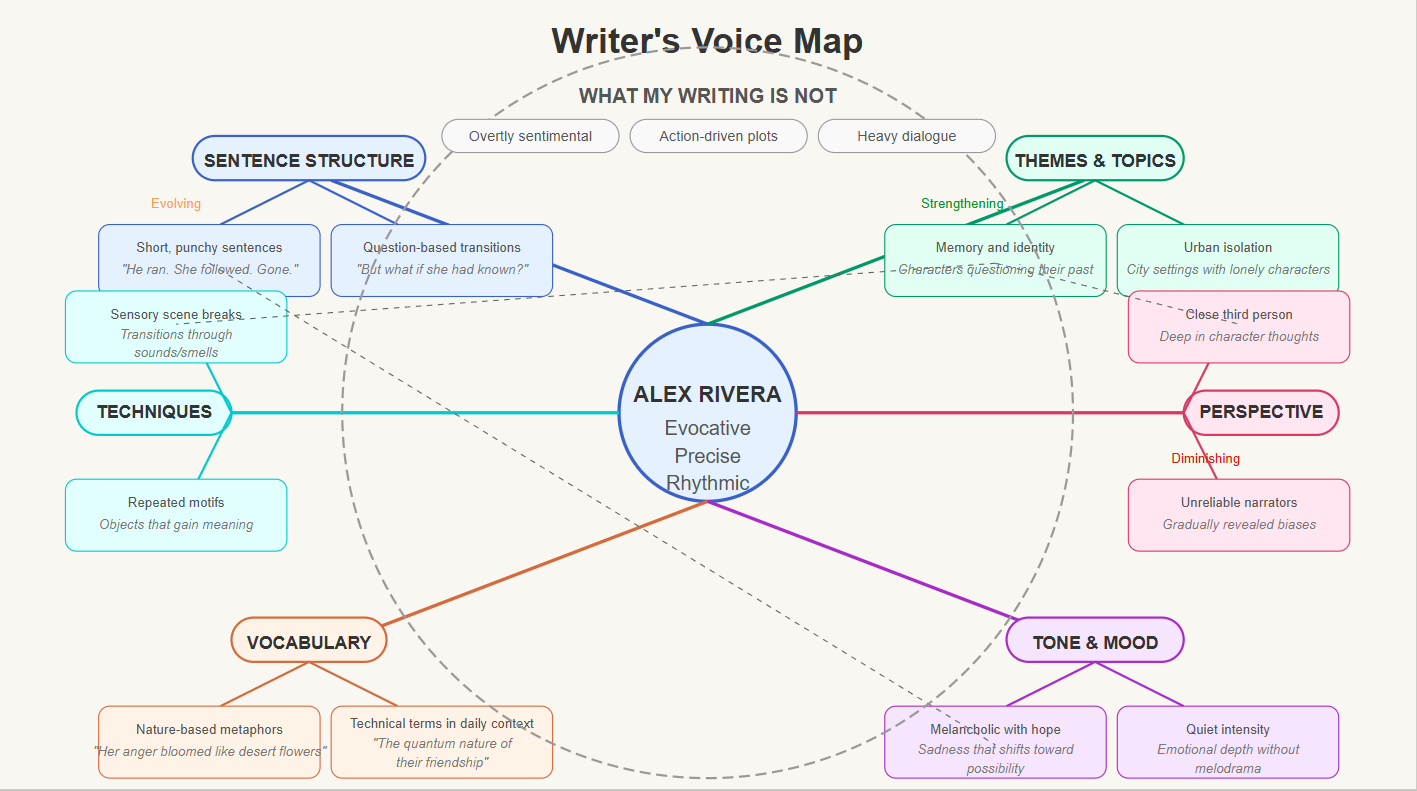
Finding Your Voice with AI
Here’s what you’re going to do after this session:
Pull up your last 5-10 pieces of writing. Emails, posts, whatever feels natural.
Not your “best” work. Your normal work. Read them out loud. Yes, out loud.
Then answer (or ask AI to help you understand your own style):
What phrases show up repeatedly?
Write them down. Those are your verbal tics. Your signature.Where do you break the rules?
Run-on sentences? Fragments? Starting with “And”?
Don’t fix them. That’s your rhythm.What would you never say?
List the words and phrases that make you cringe.
This is as important as what you DO say.What stories keep showing up?
I always come back to startups. To Remember.org. To the Camp Fire.
Your recurring stories are your anchors. And also help AI get to know you from experience, but don’t send it everything. More below.
The Invisible Erasure by Choice
A sameness is spreading through web sites and socials, texts and emails, all in the same voice. Most don’t notice it’s happening and feel it’s better and easier than doing it themselves.
Ask AI to revamp your writing following someone famous’s style, and it does exactly that. It makes your prose cleaner, more professional, less…you.
AI isn’t trying to erase your individuality. It’s optimizes for patterns, and patterns mean “sounds like everyone else.” AI was trained on millions of documents that follow certain rules. When you ask it to “improve” your writing, it’s really asking: “How can I make this sound more like the average of everything I’ve seen?”
Maybe you can know more about your own patterns and improve them, then relying on something to guide you to what everyone else likely would do.
The Voice Map Exercise
Here’s a practical exercise that works better than a prompt engineering guide:
Pull up your last ten pieces of writing—emails, posts, articles, whatever feels natural to you. Your normal work, don’t cherry pick the best. Let AI help with that.
Read them out loud. Your ear will catch patterns your eye misses. Have someone else read them out loud, or even better an Ai voice, then answer these questions:
What phrases show up repeatedly? Write them down without judgment. I say “seriously” too much, “honestly” even more, and start way too many sentences with “Look.” These aren’t professional. They’re mine.
Where do you break conventional rules? Maybe you use sentence fragments. Maybe you write run-on sentences that should be three separate thoughts but you like how they flow together with just commas because it matches how you think. These “errors” are your most distinctive patterns.
What would you never say? Make a list of words and phrases that make you cringe. I don’t use “synergy,” “leverage as a verb,” or “circle back.” This negative space, what AI should avoid, defines your voice as much as what you include.
What stories keep recurring? I always come back to startups, to Remember.org reaching schools worldwide, and to the Camp Fire.
Your recurring stories are your anchors. They’re the experiences shaping how you see everything else.
And AI never will have those anchors from experience…at least not soon. That’s your edge.
The Two-Pass Method
In the first pass, I use AI for idea generation. I ask for ten angles on a topic, ask for metaphors to explain complex concepts, and generate questions my audience might have; like an interview style where AI is interviewing me.
I get raw material that I rarely use directly, and it lets me know what most others are saying over and over again.
Knowing the average helps you not be average.
In the second pass, I write in my own voice. I create ideas out of the initial rough questions and AI answers. More as a guide and also what will likely sound like everyone else.
The research is faster. The writing remains distinctly mine, or else I become that AI middle dreariness of squeaky clean perfection without the flaws I bring.
"There is a crack in everything, that’s how the light gets in"
Leonard Cohen, Anthem
When It Matters, You Write
If it matters, you write it. You write emails to important connections, nurture those rather than relying just on AI to do it for you.
So how much of the overwhelming amount of communication and information do you really need?
And is doing more and more of it solving the problem or adding to it?
Let’s say you did let AI draft something. The draft is clean but generic; could have been written by anyone.
Here’s how to put yourself back in:
Add one hyper-specific detail. Change “in a major city” to something from your experience. Use the name of the street, the color of the light at that time of day. You can’t fake real.
Break one rule on purpose. If AI gives three perfect paragraphs, split one into fragments. Or create a run-on sentence that violates rules but matches how you think through complex ideas.
Admit uncertainty. Add “I’m still figuring this out, but...” or “Here’s what I’m seeing...what’s your take?” AI rarely admits doubt. You can.
Add your signature phrase(s). Whatever your verbal tics that friends would recognize, include one. It’s like signing your work.
What You’re Actually Losing by Letting AI Do It All For You
It’s not just about “style”. You’re losing what makes people remember you. Who do you remember:
1. Perfect AI voice so clean it reeks of automation. To those receiving is you’re on auto pilot.
2. Messy style with grammatical quirks they don’t fix, the stories activating the main point, the contradictions they show rather than hide.
AI smooths all of this out. When you feed it your writing and ask for improvements, it treats your personal patterns as errors to correct.
Your run-on sentence becomes three crisp sentences. Your conversational “Look,” gets deleted as unnecessary. Your specific memory of “Chicago in February, when even the lake looks angry” becomes “a cold city in winter.”
The Better Prompts Trap
Most people can’t describe their own voice. It’s like asking a fish to describe water. You’re so immersed in your patterns, they’re invisible to you.
You don’t realize you’re losing your voice because you never knew what your voice was.
And AI can help you do this in a way that’s hard for most to do it themselves.
Working Together, Not Automation
Think of AI like you’re making a documentary. AI is your research assistant.
It can:
Find footage
Suggest angles
Draft rough cuts
YOU decide:
What story to tell
What to emphasize
What to leave out
If you let AI direct the documentary, it’ll be like the drone of perfection saying little. Without human error and habits, things get boring.
Don’t be perfect, be you.
Real Example
I use AI every day for The AI Optimist. But here’s what I do vs. what AI does:
AI’s job:
Research topics
Find counter-arguments
Generate headline options
Format transcripts
My job:
Choose what matters
Write the actual script
Add the stories
Decide what sounds like me
The work is faster. The voice is still mine. And I train it (along with Claude Skills) to do this so much faster and better. I improve my voice, quarterly at first to get it right.
Your Action Step
Take something you need to write. Instead of asking AI to write it:
Ask AI: “What are 10 ways to approach this?”
Pick the one that resonates
Write it yourself
Use AI to edit for clarity (not style)
See how different it feels when YOU stay in control.
The Big Picture
We’re not trying to avoid AI. We’re trying to avoid becoming AI.
There’s a difference between:
“AI writes like me” (you disappear)
“I write with AI’s help” (you remain)
In a world where 90% of content sounds the same, the advantage is being undeniably, unfakeably YOU.
AI can’t do that for you.
But it can help you do it faster.
This is part one of a series on adapting AI to how you think, rather than adopting AI like everyone else. Next: “Why You’re Working More Hours Since Adding AI (And What to Stop Doing).”
Want to work through this live? I’m running bi-weekly sessions where we tackle real problems with real people. Ten minutes free, then deeper work for members. No frameworks, no corporate BS—just figuring out what AI should actually do for you.
[Learn more about live sessions.]


