


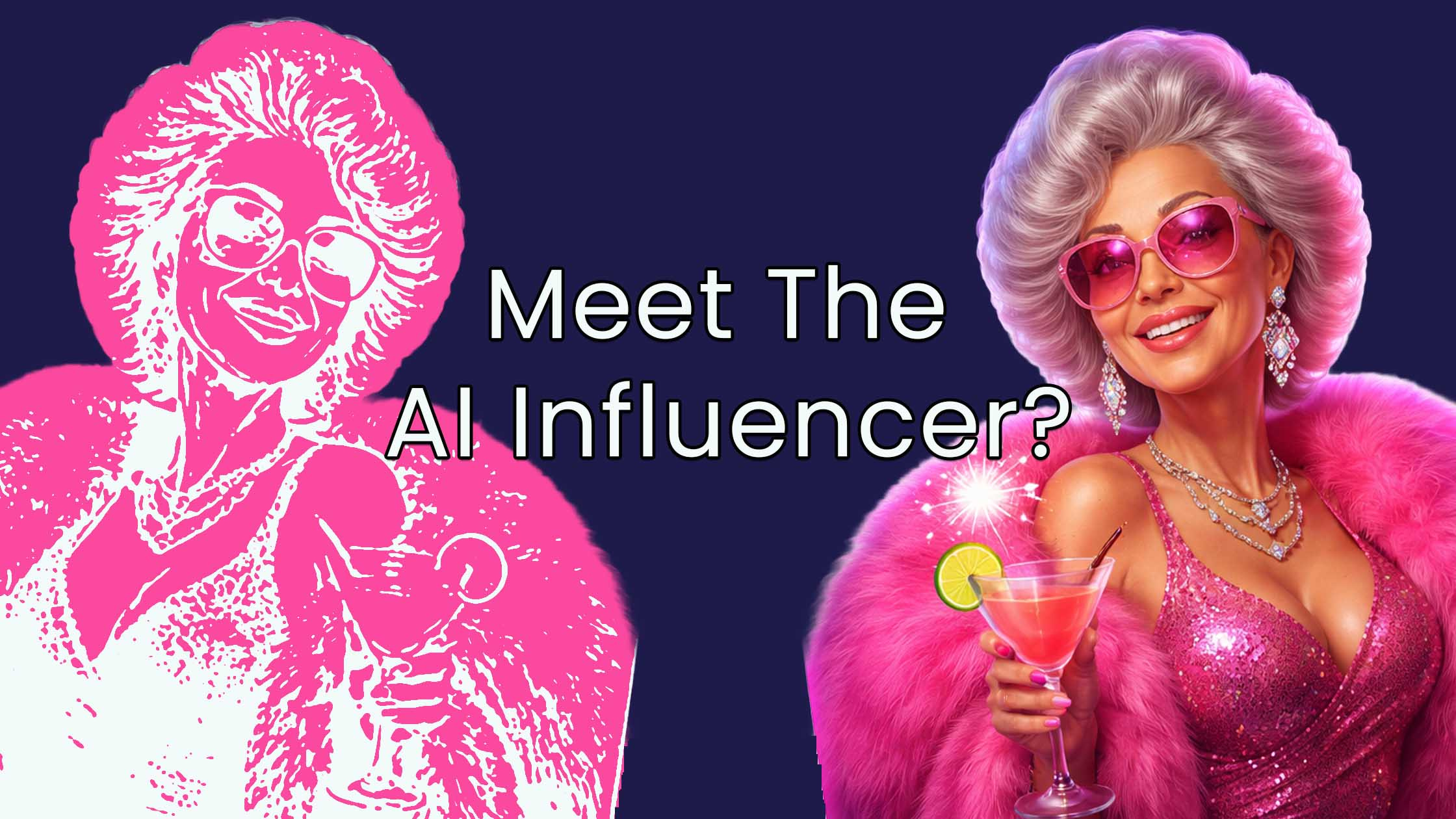
Will I ever get to meet an AI Influencer?
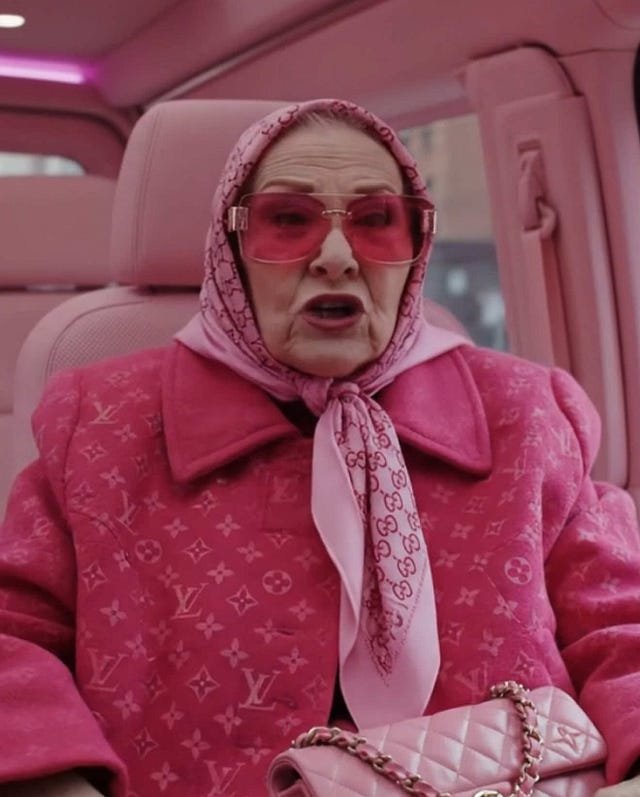
Two guys in Miami created a grandmother character who now has two million followers. She wears hot pink and lives her fictional life as a gold-digger. They built her the way writers build characters; with voice, attitude, and a world she lives in.
GrannySpills isn’t real, though by her videos it’s hard to tell. If you look closely, which viewers don’t. We hire actors to play characters. Get designers to build worlds that don’t exist.
 Tiktok failed to load.
Enable 3rd party cookies or use another browser
Before AI Influencers, only people filled those roles. Will AI Influencers change that?
No. Fame still plays by its own rules, AI or not. What’s different is who gets to try. Two creators in Miami. A group of women who flew from Atlanta to launch AI versions of themselves. Anyone with a story worth telling.
This isn’t about fake avatars replacing real people. It’s about character creation becoming available to anyone.
Some believe the best way to build influence is to become the product. Now there’s another choice.
What character would you create if you didn’t have to be the face of it?
What is an AI influencer?
The room where it happened in San Francisco, and screens where it’s always happening, merge.
Ever walk into a room and catch a glance, a face you know or once knew? Like a speaker or entertainer making so many of our monkey brains stop and snap a photo/vid.

What if that AI Influencer can “only” be met on screen, does that experience transcend meeting in person, or being a person?
I’m not sure of the answers. All I know is that happened at the AI Influencer Summit. Does fame require physical presence?
Reading Mike Gioia’s Substack piece, “What’s in a Face? AI Influencers and the 2026 AI Influencer Summit”, seeing the AI influencer characters played on screens around the hall on loop while the people who created them were speaking on stage.
And the numbers cited by Grand View Research show the impact: it valued the virtual influencer market at $6 billion in 2024, projecting $46 billion by 2030.
Are AI influencers really like Betty Crocker?

The AI Influencer roots go back to Betty Crocker being used in 1936 to sell food and recipes to 1988 Mars Blackmon, played by Spike Lee, pitching Nikes. Don’t forget the famously passive-aggressive green bird Duo for Duolingo in 2022, a fictional bird representing a brand.
AI Influencers are fictional characters for branding with identity. The map says build your personal brand, post daily, become the product. AI Influencers will do that without fail, as there’s no limits of imagination. They use data instead. They just draw on what’s worked before.
In TV we separate the actor from the words the writer wrote. In business, it’s okay to have a business persona, with the person’s life rarely revealed. Privacy.
Influencers broke that mess into a thousand pieces, connecting without huge agencies or content controlled legacy media gateways. Now there’s no separation. It’s all you doing you. Personal, transparent, and unrelenting “me” defines influence.
AI influencers are pulling them apart again. The creator goes back behind the curtain. The character goes on the screen. That’s a return to how storytelling worked before social media flattened it.
Now influencers can be real or AI; the audience looks at it as content, it doesn’t matter to them. Many listen to AI music on Spotify and don’t know it’s AI.
Whether the influencer you follow is AI matters more to those in the business than those watching.
Do faceless channels outperform personality channels?
Faceless channels are called that because there’s no human face. There’s always someone behind it.
And the whole AI influencer economy is asking what happens when voices can be manufactured infinitely. How do you know what’s real or AI?
Even our legal systems are asking this question, because every measure we have is based on human-based realities. Creativity is done only by people is a human bias, like copyright law says.
If it’s not human, no protection. By following an AI influencer, usually sharing the same type of content and persona as the most popular human influencers, they choose AI over human because of the content, not the species.
Is human better than AI automatically? Ask the people watching and listening, most don’t know it’s AI, and don’t care. It’s entertainment, news, and opinions from a source.
The leverage is in the story, not the selfie. Faces are becoming commodities designed for an audience. A teenager in Serbia can spin up a hundred of them.
The market’s answer is clear, one of the only parts of the AI market that can show it works as a business, not just an idea. Not just an AI face.

Do they outperform personality channels? It is tricky to answer, because right now AI influencers are limited to social media, and short video snippets. Traditional influencers expand with interviews and appearances in big media.
Which might happen with AI Influencers who can do Zoom calls, just not in the early days. And AI or not, finding success is seriously hard as an influencer.
The voice and the style that people are drawn to doesn’t have to come from a person. But it does demand showing up repeatedly. No human could keep up with the sheer volume of an AI Influencer.
So what’s scarce? Not the face. The voice behind it and the creative judgment. The thing that can’t be generated. Attention of the audience.
When you watch fictional characters play roles, there’s no pushback. But back in Shakespeare’s time, actors were considered a bit dangerous because they played other people. AI Influencers are simply playing, us.
Why we listen and watch them is more important than debating AI vs. human, because content doesn’t have to be human to grab attention.
Can AI replace influencers?
Every issue in AI ultimately brings up the question of replacement. Because it’s faster, smarter, and what we’re shown seems good. Most people aren’t built to be the product. AI characters don’t replace creators.
They free creators from having to perform.
We already have many AI influencers rising, and it works for some characters. Others the audience doesn’t get.
Because everyone can create a Granny character, but why is this character hitting it with the audience? We can theorize but, in the end, it is what it is. Fame and following are unpredictable.
There’s a formula to creativity, and it’s not a straight line. What a human creator brings is experience and some form of challenge or trauma to their life that spurs creativity.
Code doesn’t live for survival or know what it’s like to suffer. That doesn’t mean it can’t create content, though the idea that we have to feel to connect to people is right, and maybe a bit wrong. It’s not like what we do as humans is that interesting.
It’s the person, or AI influencer, who makes that interesting, relevant, and important to the audience.
Will AI influencers replace real ones? Wrong question. The question is whether the cult of personality was ever the right model for most creators.
We believe the only way to build influence is to become the product. What if that was always the hard way.