


The silent screaming of the massive “Stop Hiring Humans” sign at the entry to TechCrunch Disrupt let me know….
Welcome to the AI Jungle - it’s not for you, human!
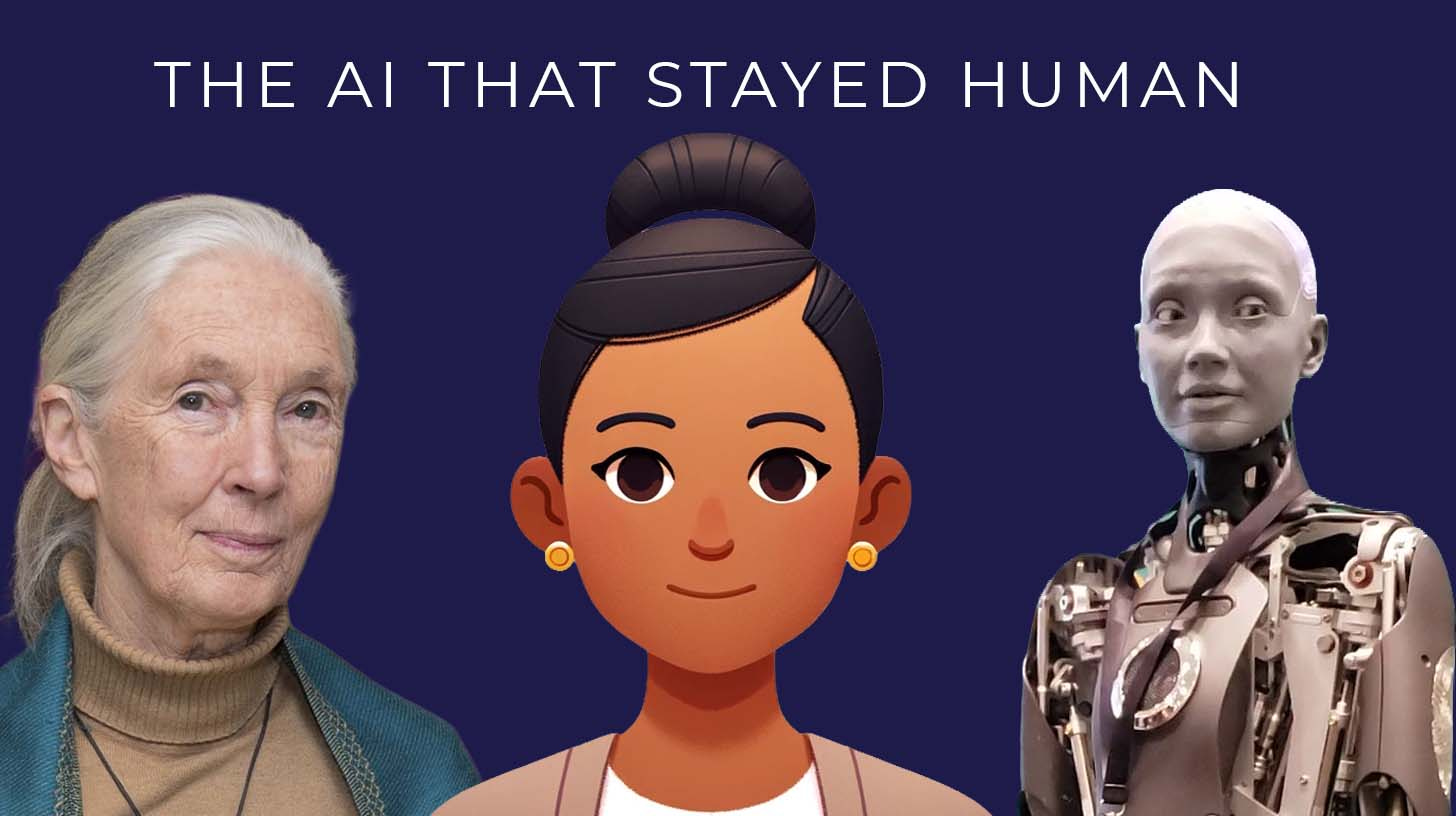
Engineers built the AI jungle with moats, not people, as their goal. Control. Now I have a choice; take the AI First side or leave, because you’re the wrong species.
I could have followed them, but I went to the deep jungle, like the anthropologist legend Jane Goodall would, and found things I could call my own.
Striding through the crowd, all the speakers, all the hundreds of AI startup booths, from countries around the world? All humans, people really. Even the ones who were buying the service to replace humans. Praising the speed and efficiency of AI over people with the dawn of robots, hyperscalers, and artificial general intelligence – AGI oooooh.
I’d try to push back, but AGI rolls out of their tongues like a lyric they love. SUPER INTELLIGENCE, smarter than humans, smartest in any class, #1!
When I ask them what they’re working on and how it works, no one knows. They were part of something big that in the end wouldn’t make them part of it. It doesn’t matter. Let’s look at why you need people to do things.
The chill it gave me, in a room of true believers, walking past row after row of tech brilliance for business and governments, was from seeing little that might improve people’s lives today. While everyone wraps their business around artificial intelligence, where is the real intelligence that serves without removing people?
I had to go deep to find a booth who owns what they do, where it’s not just what AI does, it’s what AI does for people. Because AI to me is intelligence applied to structures and problems first, not AI first.
Like Jane observing a male chimpanzee in Tanzania, I wasn’t going deep without changing.
“I had been told from school onwards that the best definition of a human being was man the tool-maker—yet I had just watched a chimp tool-maker in action. I remember that day as vividly as if it was yesterday.” — Jane Goodall
She watched David Greybeard fish for termites with a blade of grass. She’d been told this was impossible. He wasn’t performing. He was just doing what worked. Intelligence.
“Now we must redefine man, redefine tool, or accept chimpanzees as human.” — Louis Leakey, surprised and responding to Goodall’s observations
Sounds like the same question I have with AI. So many of our early efforts are to try to make AI human. We give AI names, project human yearnings for power on code, and play with the happy schadenfreude of being replaced at work and maybe eliminated from the planet because we’re not efficient. Have a good day.

Goodall discovered intelligence where nobody else could. David Greybeard isn’t human; he was able to fish and was intelligent. That discovery didn’t make us less as humans.
I’m looking for David Greybeard in a way. Intelligence with empathy, like a friend while not pretending to be human. Not artificial. Instead, I stumble around a crowd staring at a cold robot, rotating and looking at us while doing tricks. A Roomba vacuum wasn’t a Roomba because it used AI to roll on carpet. That’s a weird been there done that AI moment.
Finding RUTH
Then the booth with two large eyes. She stopped me.
Not the banner. Her face. Rendered into a simple image a design team builds in an afternoon. But no wide customer-service smile. No tilted head of practiced concern. Just a woman looking back at you with the stillness of someone who has heard hard things and didn’t look away. She helps.

TechCrunch Disrupt 2024 Booth: The Team at RUTH
Her eyes don’t ask anything of you. In a convention hall full of avatars built to sell, she looked like she was built to listen.
That’s what made me stop and ask them to interview. Helping social advocates with AI, working on some of the most difficult problems we people bring, and connecting them to intelligence specifically for them, where they live.
Most AI companies are built around what they can take from you. Your data, your attention, your trust; all of it fuel for something else, someone else’s exit. RUTH is built to give back, in a way I never thought about.
Most AI applications harvest user data, RUTH deliberately maintains zero knowledge of its users. No emails collected, no names stored, no digital breadcrumbs left behind.
Megs Shah, founder of Parasol Cooperative, shares why:
“I’ve been in data for God knows how long,” Megs explains,
“and I’ve been on the side of
‘let’s collect every possible piece of information we can about a person.’
But being on the survivor side of the mindset now, I’ve realized that could revictimize people.
The goal for us is ensuring we’re not participating in that.”
RUTH is in many countries now. Nobody got rich. Many people are getting help in a situation where the information is needed right then. That’s the point.
I found that out a year later, after Christmas.
A relative suddenly got rushed to the hospital and we weren’t sure if he’d make it out. He has a son, and in this tense time of figuring it out, a bunch of people had a bunch of ideas about what would be best for the son. Panicking because they had to plan for something that hit them out of nowhere.
We need information, people to talk to, and where to go, while we’re freaking out. Then I remembered those two empathetic eyes, RUTH the chatbot, and dove in with our situation.
Within an hour, I had contact information, a suggested list of things to consider, a guide to resolve the situation and getting help from the trusted local sources in my little rural town.
When technology does things you didn’t think possible like this, it feels like magic.
RUTH gave me answers that helped one little boy and the people taking care of him. Maybe that’s the AI that should take over the world….with us.